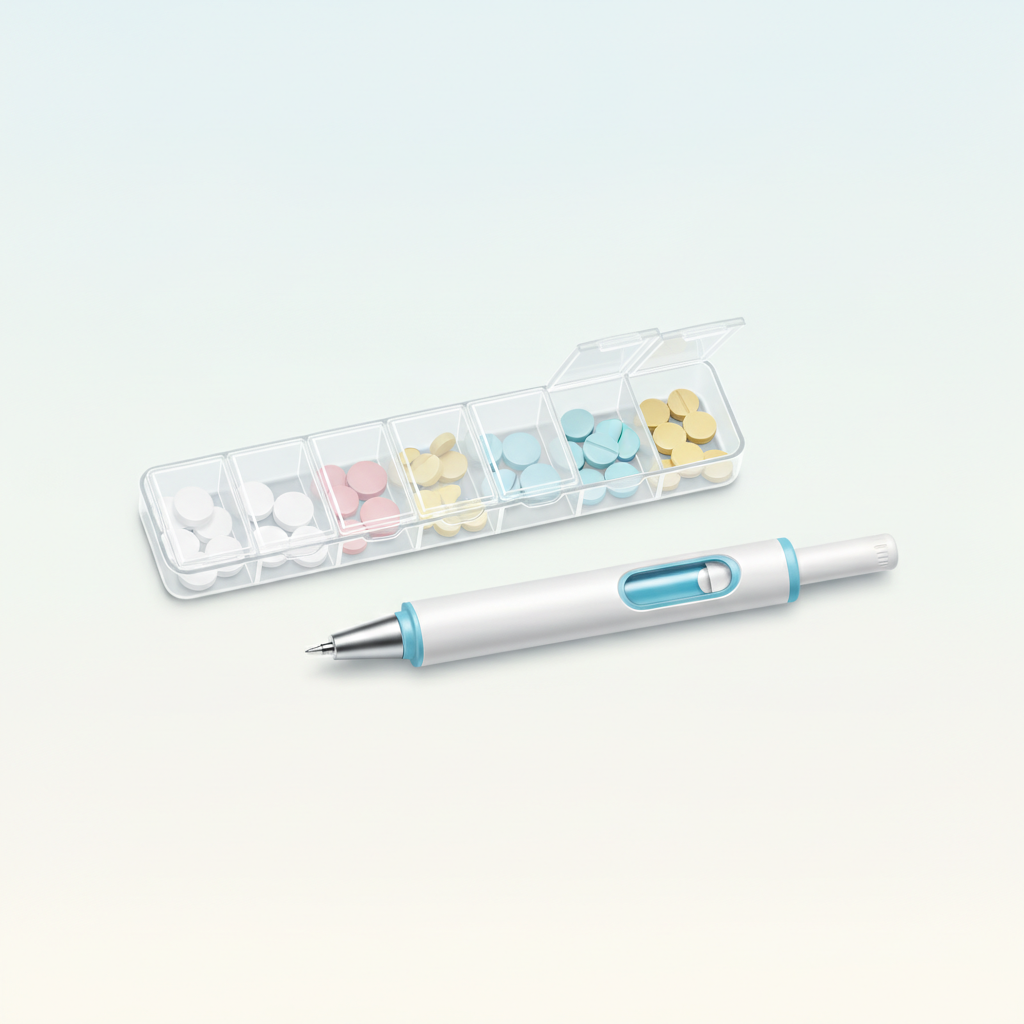
Weekly vs. Daily Pens: Pros and Cons of Each Dosing Frequency
One of the most commonly discussed practical aspects by patients starting treatment with GLP-1 receptor agonists is the dosing frequency. Some options, like liraglutide, require daily injections, while others, such as semaglutide and tirzepatide, have been developed for weekly use. In this article, we compare the practical pros and cons of each format without delving into the specific efficacy of each molecule.
Why dosing frequencies differ
The dosing frequency of an injectable medication is related to the pharmacological properties of the molecule, especially its half-life — the time it takes for the body to eliminate half of the substance. Molecules with shorter half-lives, like liraglutide, need daily replacement to maintain stable therapeutic levels in the body. On the other hand, molecules designed with specific structural modifications, such as semaglutide and tirzepatide, remain active longer, allowing for a single weekly injection.
Advantages of weekly pens
Fewer injections: a single injection per week significantly reduces how often the patient needs to handle the medication and self-administer.
Improved adherence: for many people, remembering a weekly appointment is easier than maintaining a daily routine, especially over months or years of treatment.
Convenience during travel and variable schedules: fewer injections mean less need to carry medication during frequent trips.
Possible disadvantages of weekly pens
Greater impact if a dose is missed: since the interval between doses is longer, missing a weekly dose can result in a longer period without the medication circulating in the body, depending on when the missed dose is noticed.
Less frequent dose adjustments: dose increases during titration also follow weekly or monthly intervals, which can mean a longer adaptation process in some protocols.
Advantages of daily pens
More gradual routine adjustments: because the dose is smaller and more frequent, some patients report experiencing side effects more mildly and spread out over time.
Flexible timing: daily injections can be given at any time of day, as long as they are consistent, which may fit better with some schedules.
Less impact from a single missed dose: missing one daily dose tends to have less practical consequence since the next dose is due within hours.
Possible disadvantages of daily pens
Greater discipline required: maintaining a daily injection routine over a long period can be more challenging for some patients, potentially affecting long-term adherence.
More needles and disposal: daily use means higher consumption of disposable materials and more frequent proper disposal.
Does dosing frequency affect efficacy?
It’s important to emphasize that dosing frequency alone does not determine treatment efficacy — what matters is the specific molecule, the dose achieved, and the individual patient’s response. There are both daily and weekly medications with varying efficacy profiles within the same drug class, so comparisons should always consider the specific medication, not just the dosing schedule.
How to choose between available options
In practice, choosing between a daily or weekly medication usually depends on factors such as the patient’s lifestyle and routine, history of adherence to previous treatments, personal preferences, availability of options, and medical guidance based on the clinical condition. There is no universally “better” answer — what works well for one person may not be ideal for another.
The psychological role of dosing frequency
Besides practical aspects, dosing frequency can also have a psychological component relevant to treatment adherence. Some patients report that more frequent injections reinforce the feeling of "actively managing" their health daily, while others prefer the opposite: minimizing how often they have to think about treatment, associating weekly injections with a lighter mental load throughout the week. There is no right answer here — perceptions vary widely, and it’s worth reflecting on which approach fits best with one’s routine and temperament.
Injection technique: similarities between formats
Regardless of frequency, the basic injection technique is usually similar between daily and weekly pens: the injection is given subcutaneously, typically in the abdomen, thigh, or upper arm, with recommended rotation of injection sites to reduce the risk of skin irritation. Most modern injection pens are designed for easy handling, even for patients with no prior injection experience, and initial guidance on proper technique is typically provided by the physician, pharmacist, or educational materials accompanying the medication.
Storage and practical care
Another important practical aspect is medication storage, which generally requires refrigeration before first use and can be kept at room temperature for a limited time after opening, according to specific manufacturer instructions. This applies to both daily and weekly pens, and it’s important to strictly follow storage guidelines to ensure medication efficacy, especially during travel or changes in routine.
Discussing the best option for your routine with your doctor
When discussing with your doctor which dosing frequency might be most suitable, it’s helpful to openly share details about your routine: frequent travel, irregular work hours, history of difficulty maintaining daily habits, or personal preference for more structured routines. These practical insights, combined with the doctor’s clinical evaluation of the most appropriate molecule for your health condition, help reach a decision that balances expected efficacy with your real ability to adhere to treatment over time — a factor that ultimately determines the success of any long-term therapy.
Final considerations
Both weekly and daily injection pens have specific practical advantages and challenges, and the choice between them should consider not only the molecule and its efficacy but also each patient’s routine and preferences. An open conversation with your doctor about expectations, adherence challenges, and lifestyle helps identify which format is more likely to be consistently followed throughout treatment.
FAQ
Are weekly medications more effective than daily ones?
Dosing frequency alone does not determine efficacy — what matters is the specific molecule and its dose. There are daily medications (like liraglutide) and weekly ones (like semaglutide and tirzepatide) with different efficacy profiles, but this relates to each molecule’s characteristics, not just how often it’s used.
Is missing a weekly dose worse than missing a daily dose?
Each situation has its nuances. Missing a daily dose usually has less isolated impact since the next dose is given shortly after. Missing a weekly dose can mean a longer period without medication in the body, depending on how much time has passed. In both cases, specific guidance on what to do after a missed dose should be obtained from your doctor or the medication’s package insert.
Is it possible to switch from a daily to a weekly medication?
Yes, this is a relatively common transition in clinical practice, especially when patients seek more convenience. However, the switch should be managed by a doctor who will assess the appropriate timing, adjust doses as needed, and monitor the response to the new treatment.
Does daily injection hurt more than weekly?
Not necessarily. The needles used in both daily and weekly injection pens are usually very thin and short, and reported discomfort is generally minimal. Pain perception is individual and may depend more on injection technique and site than on dosing frequency.